
Crawlability, indexing and signals
We review indexability, canonicalisation, redirects, site structure, sitemap coverage, page speed and other technical signals that affect how search engines access and interpret the site.
SEO · THE DETAIL
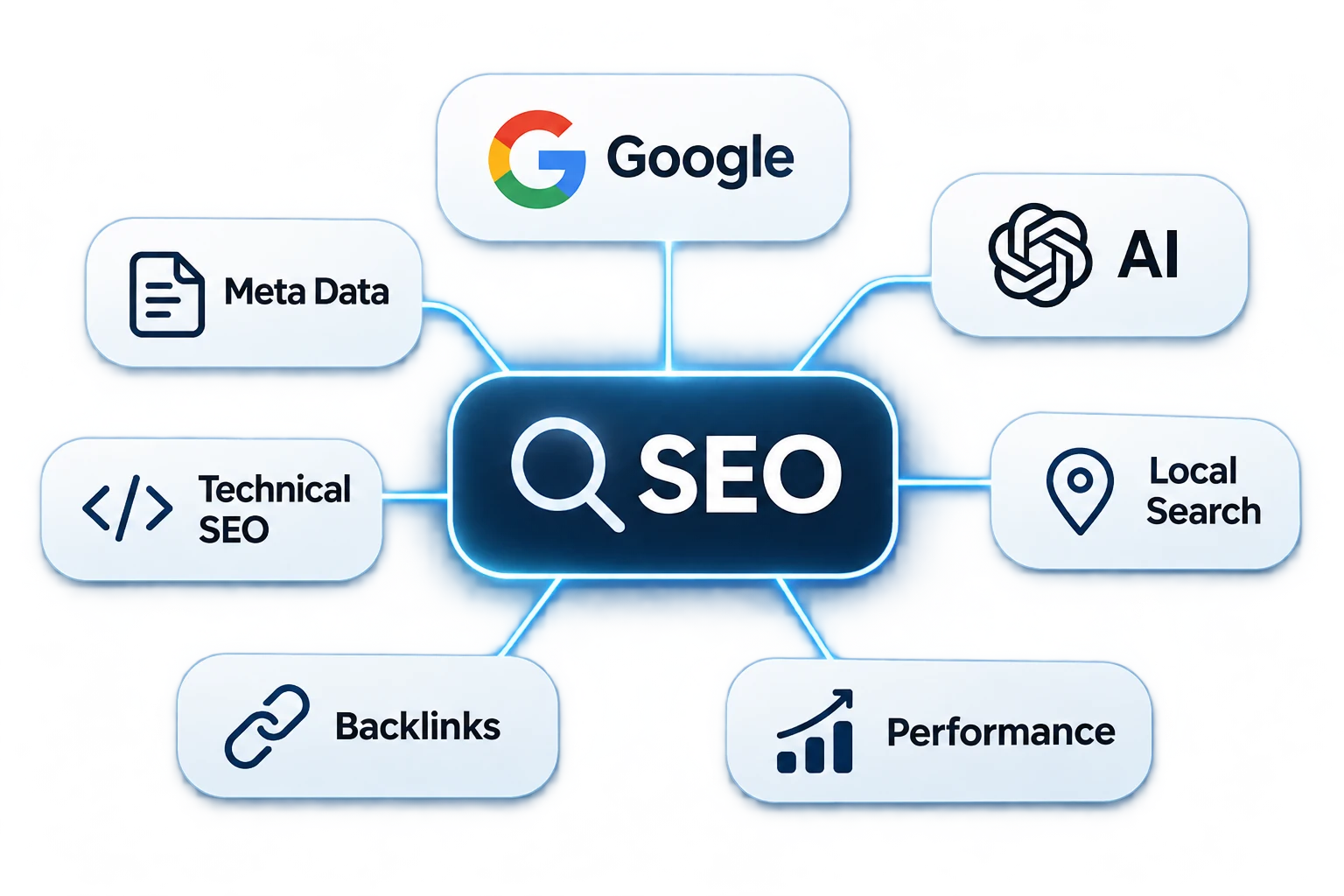
SEO is not just a rankings exercise. We combine technical SEO, search-intent analysis, on-page optimisation, authority building, local visibility and AI search optimisation to help the right customers discover the business more often — then land on pages that are strong enough to convert that visibility into real opportunities.
Before chasing rankings, we look at whether important pages can be crawled and indexed, whether their subject is clear, whether internal links reinforce the right topics and whether the website gives Google and other search systems enough context to understand the business. That foundation matters because visibility becomes more valuable when the page itself is relevant, credible and commercially useful.
We review indexability, canonicalisation, redirects, site structure, sitemap coverage, page speed and other technical signals that affect how search engines access and interpret the site.
Titles, descriptions, headings, internal links and page copy are refined so the purpose of each page is obvious to both customers and search engines.
We focus on the language customers actually use and the commercial intent behind it, rather than simply repeating a list of keywords.
SEO is not a one-off switch. Rankings move, competitors publish, customer language changes and search engines alter how results are selected and displayed. Ongoing SEO gives us a feedback loop: measure what is happening, understand why, refine the right pages and keep improving the areas most likely to create useful search visibility and new work.
Search Console data can show impressions, clicks, query themes and which pages are gaining or losing visibility. We use that information to decide what is worth refining rather than changing pages blindly.
Existing pages can often be improved by clarifying intent, filling genuine information gaps, strengthening internal links or making the content more useful to the person who has landed there.
Relevant third-party mentions and links can strengthen authority. We prefer credible, contextually relevant opportunities over bulk link-building that exists only to manufacture a metric.
Where geography genuinely matters, local signals can help a business appear for location-sensitive searches. This is most useful when the business actually serves customers in those areas rather than creating thin location pages.
A local specialist can benefit from stronger service pages, relevant geographic signals, better metadata and clearer local intent so the business appears more often for searches that are close to becoming an enquiry.
An advisory or professional services firm can build deeper pages around valuable niches, technical subjects and frequently asked questions, creating more routes into the site and demonstrating expertise before the prospect ever makes contact.
For a business with multiple products or services, better category structure, search-intent mapping, internal links and ongoing optimisation can create visibility across a much broader set of commercial searches rather than relying on one or two headline keywords.
The aim is to grow qualified visibility over time: more useful impressions, more relevant clicks, stronger landing pages, more enquiries and ultimately more opportunities for the business to win work.
Customers increasingly use AI assistants and AI-enhanced search to research suppliers, compare options and ask more conversational questions. There is no guaranteed route into an AI recommendation, but there are sensible ways to make a business easier for these systems to understand.
Clear service descriptions, consistent business information and strong topical context help systems understand who the business is and what it does.
Detailed, original and well-structured information gives both search engines and AI systems more useful material from which to understand expertise and relevance.
Mentions, links, reputable profiles and consistent information across the web can help reinforce that the business is real, established and associated with its stated services.
Good SEO writing is not about forcing the same keyword into every paragraph. We group related searches around the intent of the page, use natural variations and make sure the content genuinely deserves to rank for the subject.
A page might principally target SEO services, while naturally discussing technical SEO, ongoing SEO, local SEO, AI SEO, search visibility, Google search and related concepts where they are relevant.
Dedicated service pages give the site distinct URLs for Websites, SEO and Apps. The homepage can remain a strong overview while deeper pages provide the technical depth and topical coverage that would otherwise make the homepage bloated.
Terms such as AI SEO, AI search optimisation, ChatGPT SEO and AI search visibility are evolving. We use them where they match what customers are actually trying to understand, while keeping the underlying work grounded in strong search fundamentals.
These are the questions that usually sit behind a serious website, SEO or app project.
AI SEO is a practical label for improving the signals that help AI-powered search and recommendation systems understand a business, its services and its relevance. It overlaps heavily with technical SEO, useful content, authority and clear business information.
No. AI systems choose and generate answers in different ways and no responsible provider can guarantee inclusion. The realistic aim is to make the business easier to understand, verify and surface when it is genuinely relevant.
Search behaviour, competitors, rankings and platform features change. Ongoing SEO lets us monitor real performance, identify movement and keep improving the areas most likely to create useful visibility.
No. SEO is a standalone service. We can review an existing website, identify the technical and content priorities, complete the initial SEO Core work and then continue with an ongoing package if appropriate.
The technical detail matters, but the starting point is still simple: what are you trying to improve, and what would a better result look like?